Alsadaany Industries
KIMI
Home Assistant Robot
A production robot that moves through the home, understands what it is asked, and does the work.
Starting at
$10,500
USD
Overview
A robot built for the rooms people actually live in.
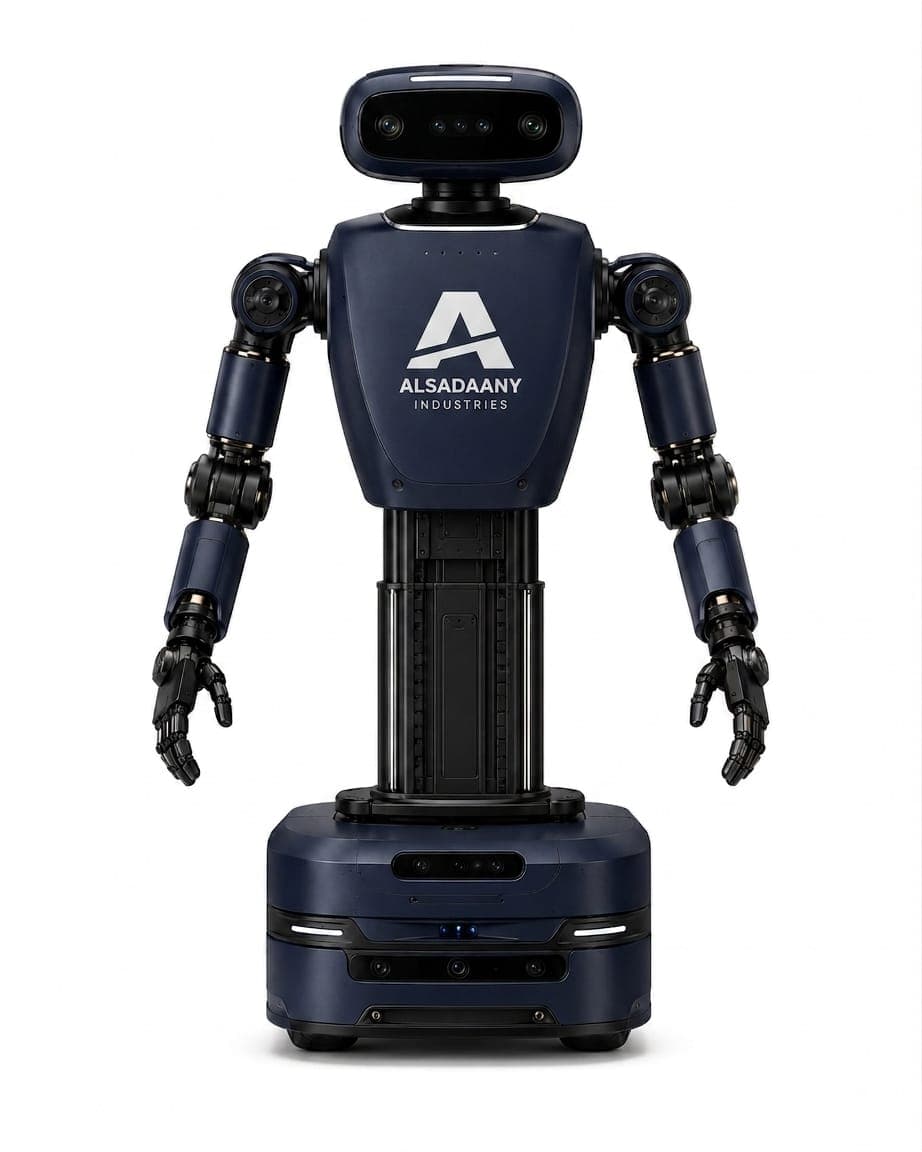
KIMI moves through indoor space, sees what is in front of it, takes instructions in ordinary language, and uses two hands to do the work. A home is cluttered, occupied and different every day. The wheeled base, the adjustable height and the five-digit hands all follow from working in one.
- 145–170cm
- Works at any height
A telescoping torso puts the arms at a low coffee table or a kitchen counter without moving the base.
- 3–5kg per arm
- Two hands, five digits each
Four fingers and an opposed thumb per hand, so objects are gripped and enclosed rather than pushed.
- 5lenses
- Sees in three dimensions
A stereo pair spaced the full width of the head, with a central cluster between them, builds a live model of the room and the people in it.
- 3–5hours per charge
- Charges itself
Returns to its dock unattended when it is not working, then resumes where it left off.
Capabilities
What it does.
Eight areas of work KIMI takes on, from fetching a single object to keeping a room in order.
Object retrieval
Locates an everyday object on request, plans a route to it, and brings it back to the person who asked.
Carrying
Transports items between rooms, so the trip is handed off rather than the decision behind it.
Organization
Returns objects to where they belong and keeps shared surfaces in order.
Navigation
Moves through occupied indoor space, holding a map of the home while detecting obstacles and people in its path.
Interaction
Takes instructions in ordinary spoken language, and asks rather than guesses when one is ambiguous.
Assistance
Takes on the repetitive household activities that are individually trivial and collectively expensive in time.
Smart home
Works with compatible smart-home systems, so a request can end in a command as easily as in a physical action.
Environmental awareness
Builds a working understanding of the objects, people, rooms and context that give an instruction its meaning.
Everyday assistance
Five sentences, and everything behind them.
Five ordinary sentences, and the work each one asks of the machine.
Bring me the bottle.
What it requires
Resolves which bottle, finds it in the room it was left in, chooses a grasp that suits its shape, and returns to the person who asked.
Put this on the table.
What it requires
Understands what “this” refers to in the moment it is said, identifies the surface meant by “the table”, and places rather than drops.
Take this to the kitchen.
What it requires
Holds the object stable while crossing a mapped home, planning around furniture, doorways and people who move.
Help organize these objects.
What it requires
Groups items that belong together, infers where each is usually kept, and works through a set without being told each step.
Go to the living room.
What it requires
Maps a named room to a location, then reaches it without collision. It is the movement everything else is built on top of.
Perception
Reads a room it has never seen.
Before KIMI can be asked for anything, it works out what is in front of it: where the floor ends, which shape is a person, and which of the objects on the counter is the one that was meant.
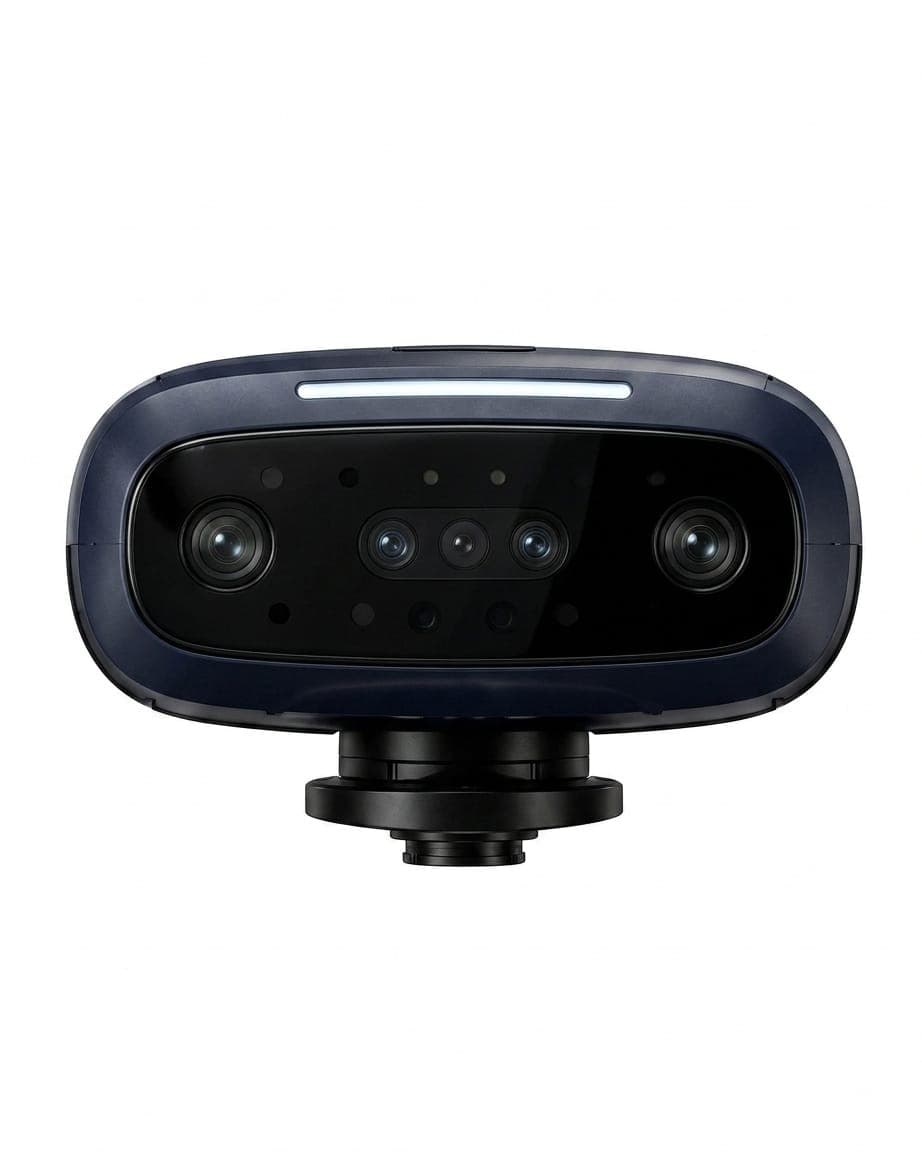
The head
- Stereo pair
- Two lenses at the outer edges of the fascia, spaced the full width of the housing apart. That separation is what a stereo pair needs to recover depth.
- Central cluster
- Three further lenses grouped at the centre of the glass, between the outer pair.
- Sensor array
- Rows of apertures above and below the lenses, carrying the audio and short-range sensing package.
- Status strip
- A continuous light strip across the top of the housing, so the machine's state is legible from across a room.
- Articulated mount
- The head turns on its own mount, independently of the body, so the robot can look without driving.
Sensing
- RGB cameras
- Depth sensing
- 3D LiDAR (optional)
- Inertial measurement unit
- Microphone array
Person detection
Recognises that a person is present and adjusts its movement accordingly, in a space it shares rather than owns.
Object detection
Identifies everyday household objects and tracks them well enough to be asked for one by name.
Depth and spatial understanding
Judges distance and free space, which is what separates a map of a room from a photograph of one.
Obstacle detection
Detects what was not on the map (a bag, a chair moved since yesterday, a pet) and routes around it.
Room understanding
Associates places with names, so “the kitchen” is a destination rather than a coordinate someone has to supply.
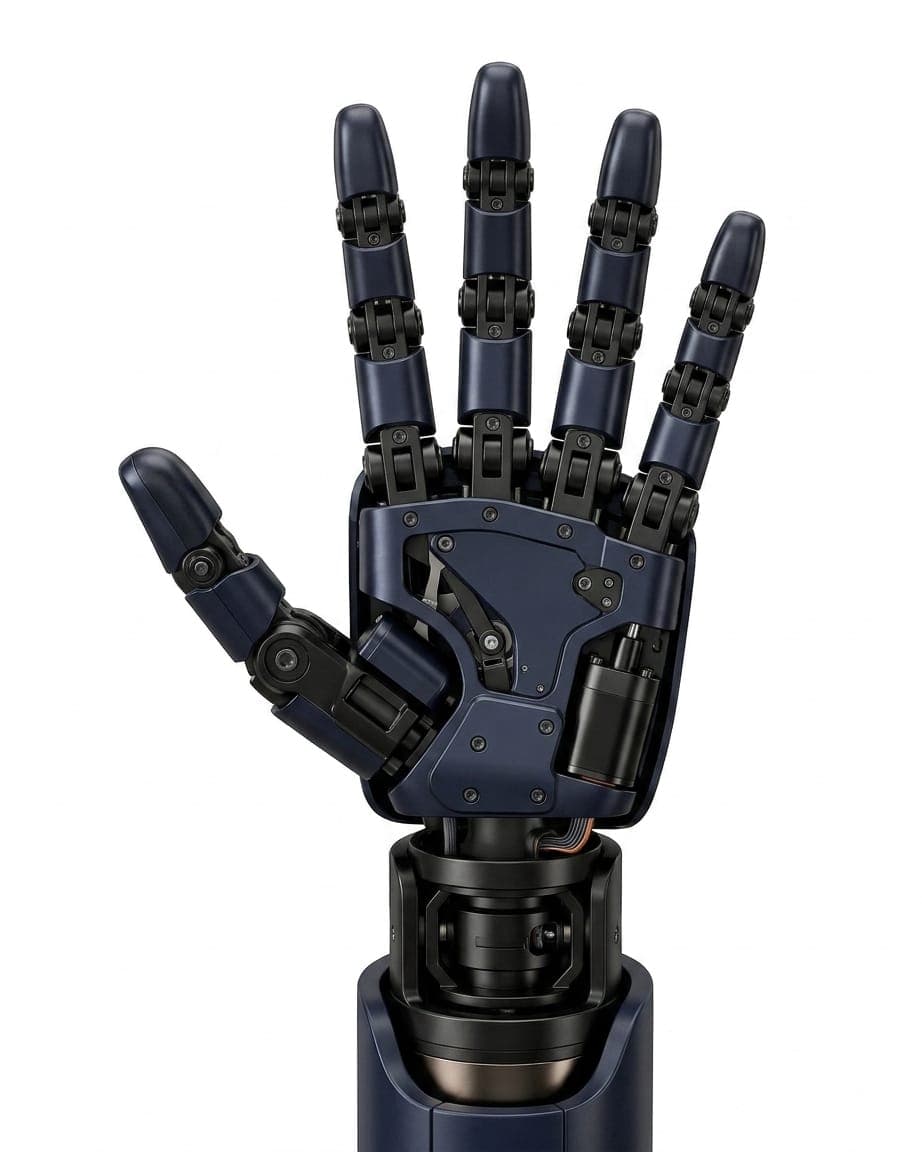
Manipulation
Made to interact with the physical world.
A home is built entirely around hands. Door handles, kettles, laundry, the way a mug is picked up rather than pushed. All of it assumes fingers and an opposed thumb.
- Five digits
- Four fingers and a thumb mounted in opposition, which is what allows an object to be pinched and enclosed rather than only pushed.
- Three segments each
- Every finger is built from three articulated segments over black joints, so a digit wraps a curved surface instead of closing flat against it.
- Palm linkage
- The palm plate carries its own internal linkage and actuator module, rather than driving the fingers from the forearm alone.
- Wrist articulation
- The hand meets the forearm through a wrist joint, so an approach angle changes without the whole arm moving.
3–5
kg per arm
Intended tasks
- Picking up objects
- Placing objects
- Carrying objects
- Sorting objects
- Repositioning objects
- Interacting with household items
Intelligence
Intelligence built for the physical world.
A robot that can hold a conversation but cannot find the bottle is not useful. The work is in the join: an instruction has to become a thing in a room, a route to it, a grasp, and a check that the grasp worked.
Language
An instruction arrives as a sentence, not a command. It is read for intent, for the objects it names and for what it leaves unsaid.
Perception
The words are grounded in what the cameras see. “The bottle” becomes a specific object at a specific place in the room.
Planning
Intent becomes a sequence: where to drive, what to reach for, in what order, and what to do when a step does not go as modelled.
Action
The base and the arms execute, and the result is checked against perception as it runs rather than assumed to have worked.
What it runs
Computer vision
Object recognition and scene understanding, so the robot's model of a room is made of things rather than of obstacles.
Natural-language interaction
Instructions given the way they would be given to a person, with clarification asked for rather than assumed.
Task planning
Decomposition of a stated goal into an ordered sequence the platform executes.
Contextual grounding
Resolving what “this”, “there” and “the usual place” refer to, which is where most household instructions live.
On-device inference
Perception and control run on the robot, so the loop that keeps it safe does not depend on a network round trip.
Optional cloud intelligence
Heavier reasoning can run off-device where latency allows. It remains optional.
Design
Designed around the work, not around the idea of a robot.
Every decision visible here is a decision about a house: flat floors, doorways, counters at two heights, and people moving through the same space at the same time.
Front elevation
Everything a person deals with faces forward.
The sensors, the status light, the chest mark and both hands sit on one face. A person approaching KIMI can tell where it is looking and what it is doing without walking around it.
Designed from every angle.
A robot in a home is seen from behind as often as from the front when it leaves a room, works at a counter, or waits out of the way. The back of this machine is finished, not left over.
- Sensing faces forward
- The back of the head is a plain housing. Every lens and aperture is on the front face, which is a statement about where the robot is expected to be looking.
- The column is left exposed
- The vertical lift is visible from behind rather than shrouded in bodywork. The mechanism that sets the working height, in plain view.
- Panels, and their fasteners
- The rear shell is a set of discrete panels with their fixings visible, so the machine can be opened and serviced rather than replaced.
- Lighting continues around
- The light strips on the base run to the rear as well as the front, so the robot stays legible to a person standing behind it.
Described from the official rear render only. Internal layout, ports and serviceable components are not shown and are not claimed here.
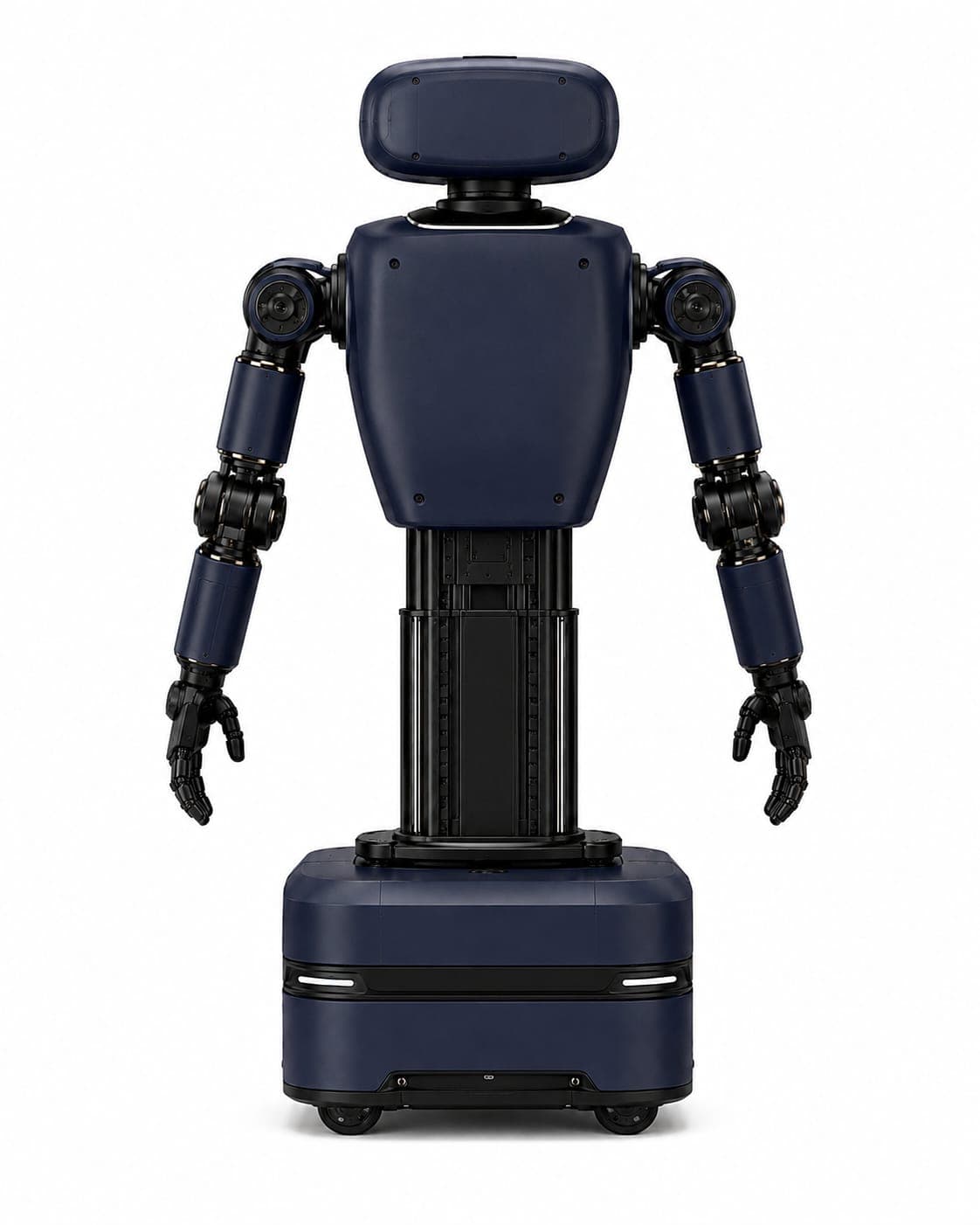
Rear elevation
Design principles
Mobile
A wheeled base, not legs
A powered wheeled base moves efficiently across the flat, continuous floors a home is already built from, without spending the platform's entire power and control budget on staying upright.
Adaptive
Working height that changes
The torso rides on a vertical column, so the arms meet a low table and a kitchen counter without the whole robot being sized for the taller of the two.
Manipulative
Two arms, five-digit hands
Two articulated arms ending in hands with four fingers and an opposed thumb. Two of them, because holding an object steady while doing something to it is most of household work.
Perceptive
Sensing at eye level
The head carries the perception hardware and sits at the height of the people it works with, which is also where it is easiest to tell what the robot is attending to.
Stable
Mass kept low
The base is wide and heavy relative to the torso above it, so the platform stays settled when an arm is extended out over its edge.
Serviceable
Built to be opened
The rear shell is a set of discrete panels on visible fasteners, and the lift column is left exposed rather than shrouded. It is an architecture built to be maintained rather than sealed.
What you get
One machine, five parts.
KIMI ships as a complete system. Each part is built to be serviced and replaced independently of the others.
Sensor head
Stereo camera pair, central sensor cluster, microphone array and status strip, on an articulated mount that turns independently of the body.
Two arms and hands
6–7 degrees of freedom per arm, ending in five-digit hands with three articulated segments per finger.
Telescoping torso
The vertical lift that sets working height, giving 20–30 cm of travel between a low table and a counter.
Mobile base
The powered wheeled platform and drive system, keeping mass low and wide enough to stay settled under a full reach.
Charging dock
The station the robot returns to on its own. Docking and charging are unattended.
Setup
Working the same day it arrives.
Place the dock
Choose a wall position with a power outlet. The dock is the robot's home position and the point it returns to when it is not working.
Let it map
KIMI drives the accessible floor area and builds a map of the space, including the obstacles that are permanent and the routes between rooms.
Name the rooms
Label the map in ordinary language. “The kitchen” becomes a destination, which is what lets an instruction refer to a place instead of a coordinate.
Start asking
Speak to it. Instructions are given the way they would be given to a person, and it asks when something is ambiguous.
Applications
Built for indoor space, wherever it is.
- Private homes
- The environment the platform is built around: flat continuous floors, doorways, counters at two heights, and people moving through the same space.
- Accessibility support
- Retrieving and carrying for people who find repeated trips across a home difficult, without rearranging the home to suit a machine.
- Serviced apartments
- Turnover and tidying tasks across repeat layouts, where the same map serves many identical units.
- Workplaces
- Small offices and studios where fetching, carrying and keeping shared surfaces in order is everyone's least favourite job.
Specifications
Specifications.
Full technical specification for the shipping configuration. Figures given as ranges are configurable or adjustable in operation.
Physical
- 145–170cm
- Working heightAdjustable in operation
- 20–30cm
- Column travel
- 65–85kg
- WeightBy configuration
Mobility
- 2.0m/s
- Maximum speedUp to
- 0.5–1.0m/s
- Indoor operating speed
Manipulation
- 6–7DoF
- Per arm
- 3–5kg
- Payload per arm
- 5digits
- Per hand
Power
- 1.0–1.5kWh
- BatteryBy configuration
- 3–5hours
- Mixed-use runtime
Platform
- Type
- Autonomous mobile manipulation robot
- Drive
- Powered wheeled base
- Charging
- Autonomous docking
Perception
- Cameras
- RGB
- Depth
- Depth sensing
- LiDAR
- 3D LiDAR, optional
- Motion
- Inertial measurement unit
- Audio
- Microphone array
Compute and connectivity
- AI
- On-device inference
- Wireless
- Wi-Fi, Bluetooth
- Cellular
- 5G, optional
- Middleware
- ROS 2 compatibility
- Updates
- Over-the-air
Pricing
Pricing
Starting at$10,500USD
Configure the machine to the space it will work in, and we will quote it.
- What is included
- The robot, its two arms and hands, the sensor head, the telescoping torso and the charging dock.
- What varies
- Configuration, region, support terms and options such as 3D LiDAR and 5G.
- How to order
- Request a quote or book a demonstration. Every order is quoted and confirmed before it is placed, and the $200 USD deposit that confirms it is fully refundable.
Pricing varies by configuration, region and support terms. Every order is quoted before it is placed.
Order
Get KIMI.
Request a quote, book a demonstration, or place an order. We reply directly.
- Sales
- kimi@alsadaany.com
- Manufacturer
- Alsadaany Industries
- Price
- Starting at $10,500 USD. Quoted by configuration.
- Deposit
- $200 USD, fully refundable. No payment is taken on this site. The deposit confirms a quoted order, is credited against the balance, and is refunded in full, with no fee deducted, at any time before dispatch. Refund policy.
The company
KIMI is built by Alsadaany Industries.

Trust Alsadaany. Trust the Quality.
An Egyptian company building executable digital twins and simulation systems: models of factories, terminals, fleets and infrastructure that can be run forward, so a change can be tested before it is committed in the physical world.
KIMI is the physical execution end of that stack. The discipline that goes into modelling a system before it is built is exactly what a robot needs to work in a room it has never seen: a model of the space, a model of the task, and a check against what actually happened.